

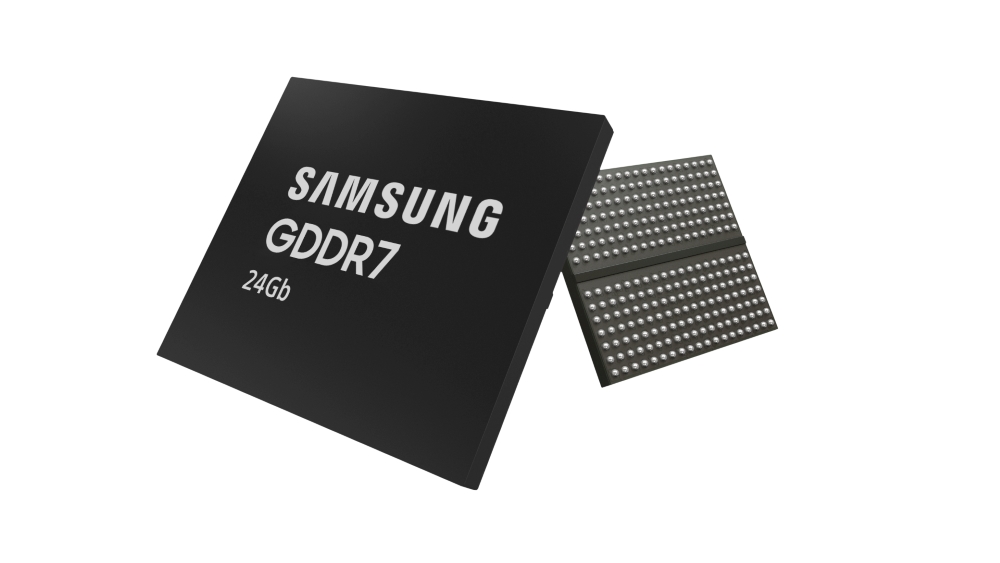
24 gigabit Gb GDDR7 DRAM
By announcing the creation of the first 24-gigabit (Gb) GDDR7 DRAM in the industry, Samsung Electronics has raised the bar for high-performance memory products. With the industry’s largest capacity and unmatched speed, the GDDR7 is the perfect option for applications of the future. Because of its 24Gb capacity, it can be used in a wide range of industries outside of typical graphics applications, including data centers, AI workstations, and other high-demand computing settings. With this innovation, graphics DRAM can now be used in more applications than just graphics cards, game consoles, and autonomous driving systems.
By using three-level Pulse-Amplitude Modulation (PAM3) signaling and using an advanced technology node, the GDDR7 achieves an industry-leading graphics DRAM speed of 40 gigabits per second (Gbps), a 25% gain over the previous generation. Performance can be up to 42.5 Gbps under specific usage circumstances. Along with speed, the GDDR7’s architecture prioritizes power efficiency by utilizing technology that were previously found in mobile devices. Power efficiency is increased by more than 30% thanks to strategies like dual VDD design and clock control management, which drastically cut down on wasteful power usage.
Power gating design approaches are also incorporated into GDDR7 to reduce current leakage and improve operating stability, even at extremely high speeds. This is crucial for applications like next-generation GPUs and high-end AI systems that need constant high-speed performance with little power loss. Additionally, Samsung has taken steps to guarantee that GDDR7 DRAM can continue to operate at peak efficiency across a range of applications, enabling it to adjust to the needs of emerging technologies.
Major GPU makers plan to start validating 24Gb GDDR7 in next-generation AI computing systems later this year, with commercialization anticipated early the following year. In addition to promising to transform AI and graphics system performance, Samsung’s advancement in GDDR7 technology lays the groundwork for future high-performance computing that is more energy-efficient.